
Imagine this: A young mother brings her son to school to be tested for early entrance to kindergarten. From birth, he has proven to be exceptionally bright. He has reached every developmental milestone well before his peers. He is clever and insightful. He is teaching himself to read. He is restless at home and eager to learn. He is ready for school.
And so the child is put through a battery of tests. Academically he qualifies as gifted. But the school psychologist is not so sure.
ā€œHe called an electrical outlet a ā€˜plug,ā€™ she says dubiously, ā€œand he wasnā€™t sure what a pasture is. He is pretty smart but lacks social skills. You can enroll him now, but I think he will be one of the lowest performing students. I know you donā€™t want that.ā€
The boyā€™s mother is shocked. And angry. How can this be?, she wonders. Is it because my child is black?
That scenario took place more than 36 years ago. The mother was , now professor of education and human development at Peabody.
ā€œI hid my anger, feeling vulnerable because I wanted her to admit my son to kindergartenā€”I knew how advanced he was, and I had run out of ways to challenge him,ā€ Ford said. ā€œHe was ready for school, but I waited to enroll him until the following year. He did well for a while but became discouraged because he was bored and wasnā€™t being challenged. It took a long time to get him excited about learning again. Had this school psychologist been culturally competent, my son would have been admitted early.ā€
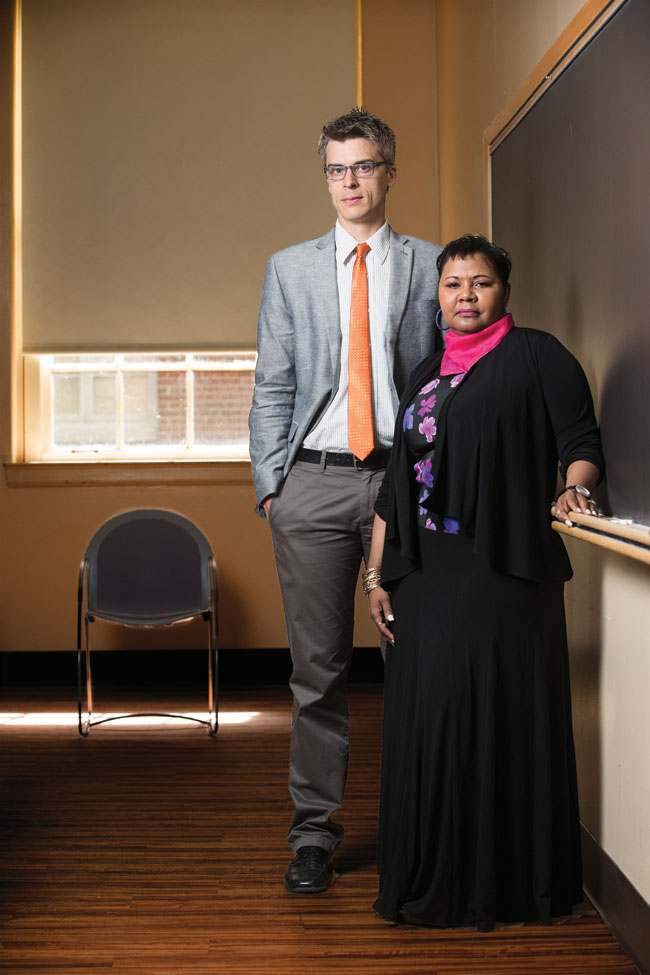
Ford shared her experience with others and found out she was not alone. Spurred by her belief that all gifted children should have equal opportunity, she went back to school and earned a doctorate in educational psychology. She has devoted her career to understanding and bringing awareness to the inequities gifted black children face.
Nearly four decades later, Ford and her colleagues find that in many ways, it hasnā€™t gotten much easier for black children to be recognized for their giftedness. In fact, among elementary school students with high standardized test scores, black students are about half as likely as their white peers to be assigned to gifted programs in math and reading, according to a recent study by , associate professor of public policy and education. Christopher Redding, a Peabody doctoral student, was co-author on the study.
ā€œItā€™s really well-documented that white students and Asian students are more likely to be assigned to gifted programs than black and Hispanic students, and the reasons for that are multifaceted,ā€ Grissom said. ā€œOur major hypothesis going into this study was that teacher discretion and the discretion of other school personnel were likely playing a big role in those patterns.ā€
After analyzing data from 10,000 kindergarteners in the U.S. Department of Educationā€™s Early Childhood Longitudinal Study, Grissom and Redding found that black students with otherwise similar characteristics, including test scores, were only a third as likely as white students to be assigned to gifted programs when their teacher was white.
In contrast, black students with similar scores were approximately as likely as white students to be assigned to gifted programs when a black teacher taught them.
“Lack of teacher diversity is a national issue, and Iā€™m going to go ahead and say a national crisis.ā€
ā€”Donna Y. Ford
Grissom noted that several different underlying mechanisms could produce that pattern. But differences in teachersā€™ perceptions are a likely candidate. In fact, in a follow-up study, Grissom, Redding and co-authors found that black/white differences in teachersā€™ ratings of studentsā€™ approaches to learning and other behavioral indicators help explain why a teacherā€™s race factors into gifted referrals.
In other words, the lens through which teachers view their students can be clouded by racialized perceptions, whether they are aware of it or not. For example, rather than recognizing a black childā€™s restlessness in the classroom as a signal that heā€™s not being challenged, the teacher may simply label him disruptive.
Previous research has found that because gifted assignment generally begins with teacher referral. This can put a black child at a distinct disadvantage. Nationally, white students in elementary school experience teacher congruence (child and teacher are of the same race) at a rate ofĀ 95 percent. By contrast, teacher congruence occurs for black students only 22 percent of the time. The effects of that incongruence could extend to the childā€™s parents as well.
ā€œParents going to a teacher, and saying, ā€˜Wait a minute, I really think my kid might be gifted,ā€™ is probably more likely if itā€™s a teacher they share a common cultural background with,ā€ Grissom said. ā€œItā€™s another way that teacher diversity can affect outcomes.ā€
Ford believes that the need for more black teachers is a critical step in reducing the underrepresentation of black students in gifted programs.
ā€œLack of teacher diversity is a national issue, and Iā€™m going to go ahead and say a national crisis,ā€ Ford said. ā€œWe must be diligent and assertive about making sure we have that representation. Having said that, the teaching force is not going to change overnight, so weā€™ve got to do everything we can at this university and every other university to make sure our teachers are culturally competent.ā€
“We have to get serious about solutions from a policy perspective.ā€
ā€”Jason Grissom
It also may be time to do away with the teacher referral paradigm, she believes.
ā€œI am an advocate for universal screening,ā€ Ford said. ā€œAdditionally, that test needs to be created with equity in mind. Test bias will always exist, so we need to be mindful of that when testing students from diverse backgrounds.ā€
A focus on student thinking is the critical lynchpin in teacher education programs at Peabody, according to , director of secondary education and associate chair for teacher education.
ā€œWhat students already know and donā€™t know, think and donā€™t think, feel and donā€™t feel are the most important resources a teacher has,ā€ Stengel said. ā€œIf I donā€™t get inside the minds and hearts of my students, then I canā€™t teach them, no matter how knowledgeable I am or how many resources I have. When students are culturally different from their teachers, it becomes even more challenging to become open to and good at reading the experience and wisdom of oneā€™s students.ā€
Nurturing cultural responsiveness in teacher candidates at Peabody is done in a variety of ways, including a required social and philosophical foundations course that critically and directly takes up issues of racism and cultural diversity. There also is required study related to English Language Learners and students with special needs.
ā€œWe work to ensure that candidates have substantial positive experiences with students from historically marginalized groups, including students of color, so that they can see these students through lenses of resource and opportunity,ā€ Stengel said.
Teacher bias may contribute to the underrepresentation of black students in gifted programsā€”only 3 percent of black students receive gifted services, as compared to 7.5 percent of white students, in U.S. public high schools. But bias is not the only culprit. A lack of access to quality pre-K and other educational resources are among many contributors.
ā€œI think we have to get serious about solutions from a policy perspective,ā€ Grissom said. ā€œAlso the higher education and research communities need to learn more about the factors that are driving these disparities and get serious about addressing them.ā€