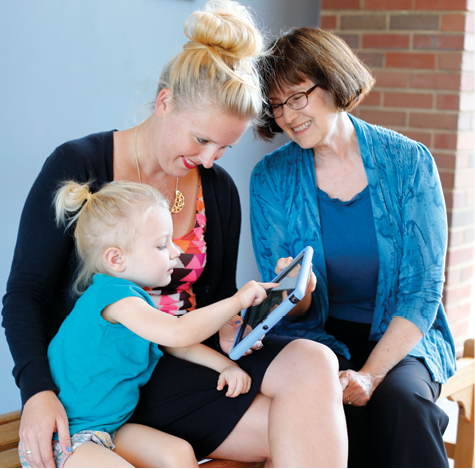
Most nights find exhausted parents cuddling up with their young children to read books before bed.Ā Whether itā€™s a hasty run-through of Goodnight, Moon or a deeper dive into Where the Wild Things Are (complete with mom or dadā€™s silly voices), parents feel good knowing they are helping their child build a foundation for early language and literacy, which supportsĀ a lifetime of learning.
But research at Peabody shows that children could be developing language and literacy skills at a significantly higher rate if parents tapped into a simple, powerful technique called dialogic questioning. Dialogic questioning isnā€™t difficult to do, according to developmental psychologist . Instead of reading the story straight through, the parent pauses occasionally to ask their child open-ended questions and engage in dialogue before moving on.
ā€œIn dialogic questioning, you are exposing children to more words, which is important,ā€ Troseth said. ā€œBut what is even more important is that you are asking the child to think about context and form inferences. When you ask them, ā€˜Whatā€™s going to happen next?ā€™ or ā€˜WhyĀ do you think that happened?ā€™ you are encouraging a deeper understanding and mastery of language that wouldnā€™t have happened otherwise.ā€
Teaching parents to use dialogic questioning
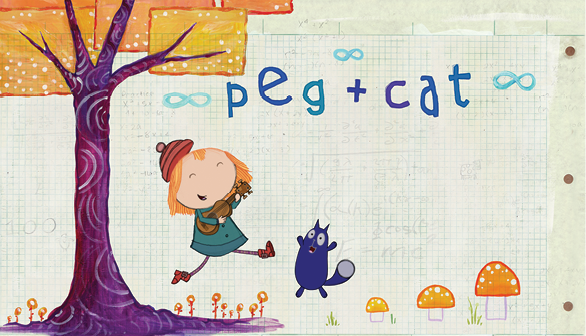
Now, with her colleagues at the 91ĢĘ²®»¢ Early Development Lab, Troseth is taking dialogic questioning to the next level by developing a special ebook based on the Emmy Award-winning PBS show Peg + Cat. The collaboration came about in part through doctoral student Colleen Russo Johnsonā€™s connection with show creator Jennifer Oxley and producer Cathy Droz at The Fred Rogers Company.
ā€œWe went into this partnership with the idea that we wanted to create something that would empower parents,ā€ Russo Johnson said. ā€œWe wanted to get them out of the mindset that the primary goal was to get to the end of the book. We hoped they would start using reading time with their children to connect, to engage and ask deeper questions that relate back to the childā€™s own life. Even if they didnā€™t finish the book, their time would be more rewarding and beneficial.ā€
ā€œWith the Peg + Cat show, as well as the books, web games and music, children seem to get more out of the experience when itā€™s shared with their parents,ā€ Oxley says.
Co-creator Billy Aronson adds, ā€œWhen the stories are shared by the whole family, they become part of an ongoing dialogue and become part of the kidsā€™ lives.ā€
Interacting withĀ an animatedĀ avatar
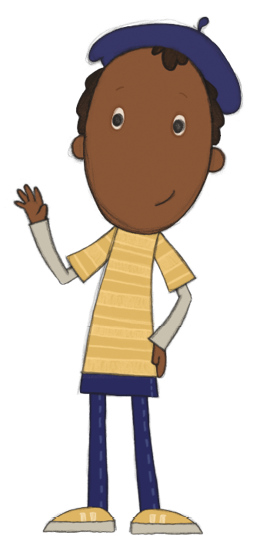
For the Peg + Cat ebook prototype, Troseth, Russo Johnson and Gabrielle Strouse, PhDā€™11 (now an assistant professor at the University of South Dakota) chose to feature an interactive avatar, a character named Ramone (right), who appears frequently on screen to suggest questions for parents to engage the child in a deeper discussion as the story goes along.
In one sequence, the main character Peg talks about the concept of height. After Peg explains what the word ā€œheightā€ means, Ramone appears and asks, ā€œWho is taller? Peg or Cat?ā€ That opens an opportunity for parent and child to talk about height as it relates to their family members.
Another unique feature is a coffee cup icon that is visible on each page. When the parent clicks on it, Ramone prompts additional discussion points. For example, when Cat is riding on Pegā€™s shoulders, Ramone prompts the parent, ā€œYou could talk about what itā€™s like to ride on someoneā€™s shoulders.ā€
While testing the prototype, the researchers found that many parents were surprisingly unaware that their interaction was so important and were glad to have Ramone on hand to encourage them to become more engaged. ā€œI would usually repeat Ramoneā€™s question, and then I would build up to asking more questions,ā€ one parent commented.
Quantity plus quality
The researchers found that during the reading session, the parents using the prototype with the Ramone character and the coffee cup icon exchanged 800 or more words with their children, compared to fewer than 200 words exchanged between parents and children who read the ebook without prompts.
In follow-up work, Troseth and colleagues want to give families a tablet containing the ebook to use for several weeks. ā€œWe predict that having the prompts in place will increase the childā€™s story comprehension as well as vocabulary,ā€ Troseth said. ā€œWe believe that this concept is a powerful way to use a touch screen as a tool for language development, not just as a babysitter.ā€
Early funding for the Peg + Cat ebook prototype came through a $10,000 grant from the Bridging the Word Gap Challenge, run by the U.S. Department of Health and Human Servicesā€™ Health Resources and Services Administration. ā€œThe word gapā€ refers to a theory that posits children in low-income homes are exposed to about 30 million fewer words by age 3 than those in middle-income families. But Troseth says that the number of words a child hears doesnā€™t tell the whole story.
Building language development
ā€œWe have about two decades of research backing up our thinking supporting the idea that itā€™s not just the number of words a child hears from their parent but the activities that parents and children do together. Engaging with the child, asking what happens next, and listening to their answersā€”thatā€™s what brings about language development.ā€
Troseth and her team are in talks with several organizations to continue developing the technology so that they can adapt it to other ebooks using different avatars and prompt icons. In the next phase of study, they will evaluate the impact of letting parents turn the avatar on or off as needed.
ā€œIn talking to parents, we are hearing that they are really tired at the end of the day and donā€™t have the energy to ask questions while reading to their children,ā€ Russo Johnson said. ā€œWe hope the app helps with that, but also that this concept of dialogic questioning becomes second nature to families and isnā€™t limited to just reading. We hope parents will engage with their children this way in lots of activitiesā€”going to the grocery store, cooking dinner together, riding in the car. Itā€™s just a great way to have quality family time and incorporate learning into everyday life.ā€
Screens vs. Humans
This current research is based on years of study spanning a broad range of delivery methods. In Troseth and Strouseā€™s early research, they studied the effects of kids videos likeĀ Baby Einstein, Dora the Explorer and Blueā€™s Clues, on preschoolersā€™ learning and found that parents are a key ingredient of success.
Their work showed that on-screen characters alone were not particularly effective in promoting cognitive development in preschoolers, even when the characters paused to ask the child questions, such as,Ā ā€œDo you see the blue house?ā€
On the other hand, when parents watched the program with their child and engaged them in dialogic questioning, the childā€™s vocabulary and story comprehension results were significantly higher than those who watched without a parent present.
ā€œFor preschoolers, it isnā€™t natural or easy for them to learn from screens,ā€ Troseth said. ā€œTheyā€™re going to learn a lot more if an adult is there with them, engaging them, just like you would with a book. A TV character or avatar may engage a child, but for learning purposes, nothing is as effective as a parent or caregiver.ā€
More about Peg + Cat
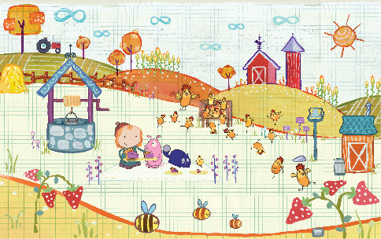 Peg + Cat is an animated math-based adventure series for preschoolers on PBS Kids. In each episode, Peg and her sidekick Cat take on a real-life problem and find a way to solve it using math.
They use song, diagrams, charts and graph paper to map out their questions and possible solutions in a quirky, comical way. Somehow, math always saves the day.
A companion website at is available to keep the learning going after the program has ended.