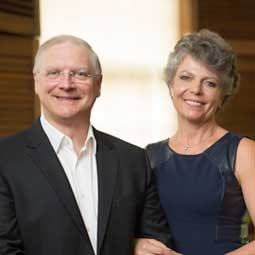
By Jennifer Kiilerich
The National Association for Gifted Children (NAGC) awarded , a doctoral student in quantitative methods; , Cornelius 91ÌƲ®»¢ Professor of Psychology Emeritus and professor emeritus of psychology and human development; and , Patricia and Rodes Hart Dean of Education and Human Development; the 2025 Gifted Child Quarterly Paper of the Year for their work, “In their own voices: Educational perspectives from intellectually precocious youth as adults.â€� They will be honored November 7 with a ceremony at NAGC’s annual convention.


Lubinski and Benbow also received the honor in 2021 for a paper on their research in gifted education. The journal’s review board applauded the new article’s rare insight beyond what is already understood about gifted education, noting that it illustrates lived developmental trajectories and personal insights from gifted learners and “carries clear implications for both policy and practice.�
“We are honored to have this work recognized,� Benbow said. “It was exciting to approach our data through a new lens—that of the real-life experiences of participants in our Study of Mathematically Precocious Youth. Their words are valuable, and their opinions and stories reiterate the importance of appropriately leveled instruction for accelerated students.�
Why the voices of gifted students matter
Between 1972 and 1979, researchers identified two cohorts of young students who scored in the top 1 percent and top .5 percent on SAT testing. The (SMPY) has tracked their progress through the decades, demonstrating time and again that advanced learners thrive when they receive accelerated instruction. That type of instruction, also known as appropriate developmental placement, involves grouping students with similarly motivated peers, providing access to challenging curricula, and moving at the right pace.
Now that the study’s first participants are well into midlife, the researchers wondered: With robust empirical evidence supporting appropriate developmental instruction, why aren’t more schools adopting it? And what further information might nudge educators to implement it more readily?
“We realized that there had not been a study that shared the collective voice of gifted learners,� Noreen said. She works on SMPY alongside Benbow and Lubinski at of education and human development. “We saw an opportunity to learn more about the feelings of the very people that accelerated instruction is designed to serve. Our hope was that insights from their lived experiences might move the needle for anybody who still felt unsure about the methodology.�
Amid recent, public pushback against gifted programs (such as proposals to do away with grouping students academically), the authors also emphasized that supporting advanced learners is good for society. “Today’s complex challenges, such as pandemics, cybersecurity, and beyond, highlight the need for exceptional problem-solvers and thinkers,� Lubinski noted.
What they found
The team compared survey responses from participants in their 20s and 30s to occupational outcomes in their 50s. They wanted to analyze gifted adults’ feedback to better understand what school had been like for them, what they thought worked well, and what did not work. The researchers also wanted to know whether people’s opinions about gifted education would change based on how their careers had gone. In other words, would those who became leaders in their field come to feel differently about the way they were educated than those who had not?
The researchers discovered a few things:
- Career paths, life outcomes, gender and study cohort did not make a notable difference in views. Those who were leaders or top creatives in their field and those who were not, and those who were full- or part-time workers or homemakers, all held a strong preference for appropriate challenge and pacing in instruction.
- Nearly 80 percent of participants in one cohort believed that schools should not eliminate homogenous grouping (the practice of grouping together students of similar abilities). Many recalled their experiences in general classrooms as high-schoolers, most often citing boredom and lack of challenge as pitfalls. But, “when grouped with similar abilities, you grow and challenge one another,� one participant said.
- The participants’ answers were also nuanced; they want kids to be able to move from group to group as needed, to de-stigmatize academic groupings, and to see a balance of grouped and ungrouped classes so that a wide range of learners can still enrich one another.
- Study participants particularly valued being sufficiently challenged, appropriate pacing of instruction, and opportunities to learn with similarly motivated peers.
- Without being asked, many gifted adults shared the importance of a well-matched educational setting. In answer to a question about what they liked the most and least about high school, nearly half spontaneously discussed appropriate developmental placement, further indicating that it’s a key factor in their learning experience.
A case for accelerating the students who need it
The Study of Mathematically Precocious Youth has been influential in policy and practice in its 50+ years. This new study furthers that research with a fresh take on the nuances and experiences involved in the education of gifted students. It also drives home the need for appropriate supports—for the good of society, and for the social and emotional health of learners.
“All students deserve the right to learn something new every day.”
Benbow and Lubinski summed up the team’s findings, saying: “By listening to the actual words of intellectually precocious youth as adults when reflecting on their lived experiences, this study provides a compelling case for the importance of responding to their academic needs when young. We call that appropriate developmental placement. That is, tailoring the curriculum to the learning readiness of each student allows them to thrive. And all students deserve the right to learn something new every day.�